
(By Tharindu Jayawardhana)
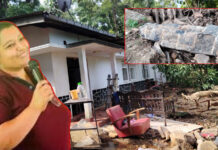
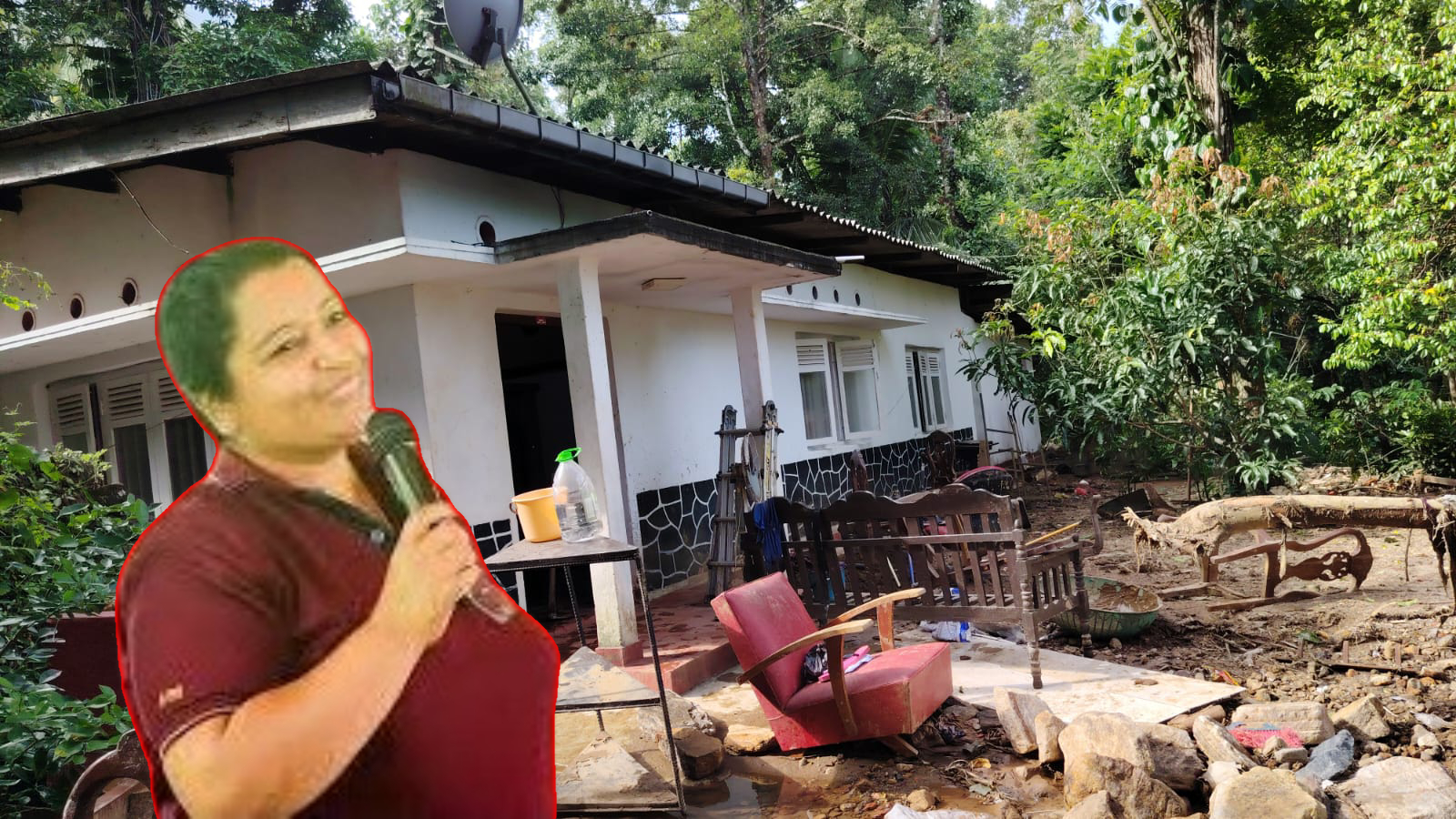
Mallika Thebuwanarachchi, a graduate of the University of Peradeniya, chose the teaching profession not only to equip thousands of children with knowledge, but also with the aim of shaping them into citizens with social and political awareness and practical experience. In the end, the playground of the very school where she devoted herself to nurturing knowledgeable citizens became her burial ground.
Mallika Thebuwanarachchi married a member of the Sri Lanka Air Force on 9 March 2006. His name is Devendra Gedara Shaminda Nayanakumara Karunasinghe. After marriage, they had a son. The boy excelled both in sports and academics. He passed the G.C.E. Ordinary Level Examination with eight “A” passes and one “B” and was preparing for the Advanced Level Examination.

With just four months remaining to celebrate the 20th wedding anniversary of Mallika and Shaminda, a decisive day arrived in their lives.
That day was 27 November 2025.
By then, Mallika had been transferred from Gampola Wewathenna Vidyalaya and was serving as a teacher at Gampola Janaraja Boys’ College, located in the Sinhapitiya area. Shaminda had retired from the Air Force as a Sergeant and was working as a training instructor at another institution. Their only son was preparing to sit for the 2026 Advanced Level Examination.
To make it easier for Mallika to travel to school, Shaminda rented a house two or three houses uphill from Janaraja Boys’ College, at the foot of the Ambuluwawa mountain. All three lived in that house. They were a close-knit and affectionate family.
Due to examination duties related to the 2025 Advanced Level Examination, Mallika was extremely busy. Yet, whenever she had a break, she never failed to conduct extra classes for her students.
On 27 November 2025, she again walked from her home to the school—just a few meters away—to conduct an extra class. After finishing the class, she returned home and, as usual, spent time talking with her husband and son.
“That Day, It Was Raining Heavily”
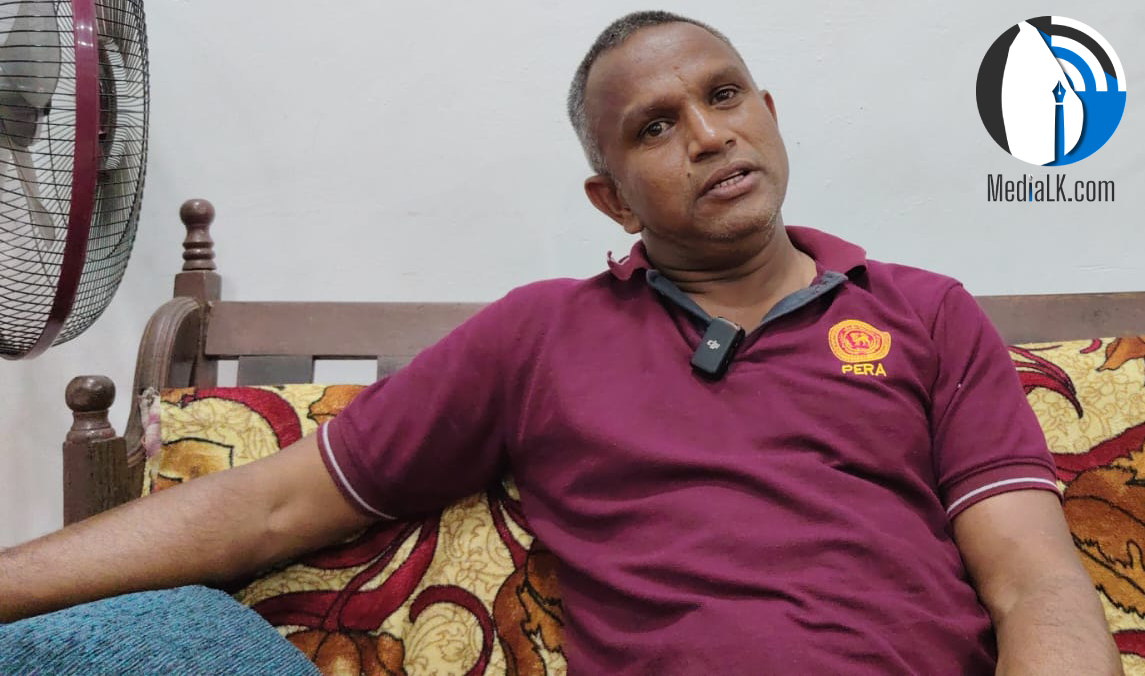
From this point onward, the incident is described by her husband, Shaminda.
“That day, there was very heavy rain. My wife left home around 8.00 a.m., saying she was going to conduct an extra class at school. She returned around 11.30 a.m. It was still raining heavily when she came back. Because of the rain, we couldn’t do the things we had planned. Around 7.00 p.m., we made roti and had dinner together. The electricity went off about twice that night.”
“After dinner, around 9.00 p.m., while we were drinking tea, my wife said she could smell raw soil. A small stream runs on the southern side of our house. When she mentioned the smell, my son and I went to check near the stream. The water was flowing normally. There was nothing unusual.”
“After a while, she again said she felt the smell of raw earth. Once again, we checked the stream and the other side of the house. There was no visible change. I closed the front door and came back inside, saying that nothing had happened.”
The Sound of Rocks Collapsing
“Just a short time after I came inside, we heard a terrifying sound, like rocks collapsing. My wife, my son, and I stood frozen, unable to speak or think. Shortly after that sound, we heard glass shattering in the back room of the house.”
“At that moment, my wife opened the front door and tried to run into the yard. A powerful surge of water came from the left side of the house and swept her away. When my son and I tried to grab her, both of us were also dragged down by the flood.”
“Between our house and the house below, there was a small embankment. Some logs carried by the water got stuck there and held us momentarily. Then another massive surge of water came. That surge threw the three of us in three different directions.”
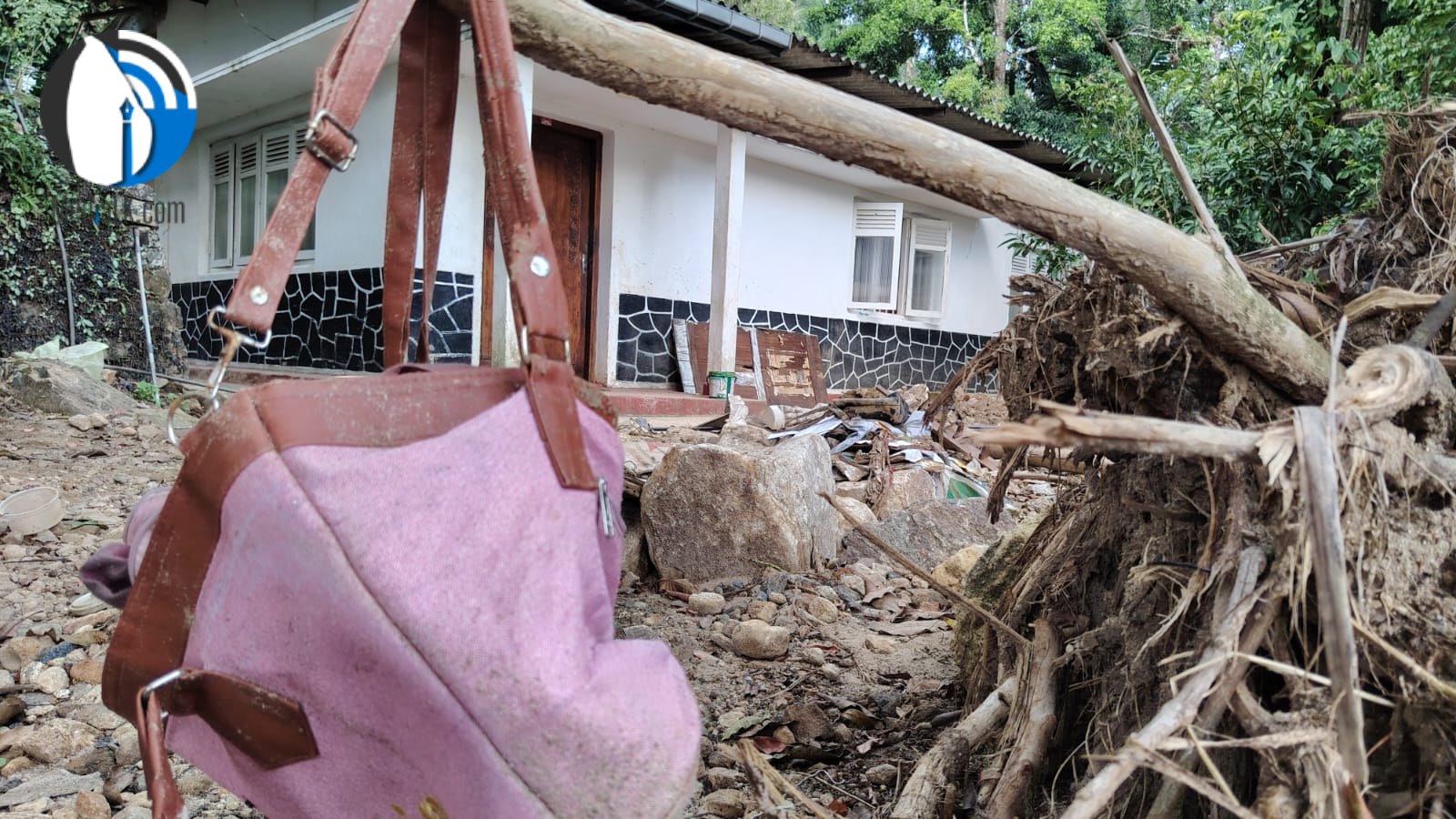
“I was dragged about 50 to 100 meters down the road. I managed to grab a concrete pole, and that saved my life. Otherwise, the mud and rocks would have carried me straight to the Janaraja school playground. By then, even the clothes I was wearing had been torn away by the water.”
“Barely managing, I went to a nearby house, borrowed a sarong, washed off the mud, and returned to our house to search for my wife and son.
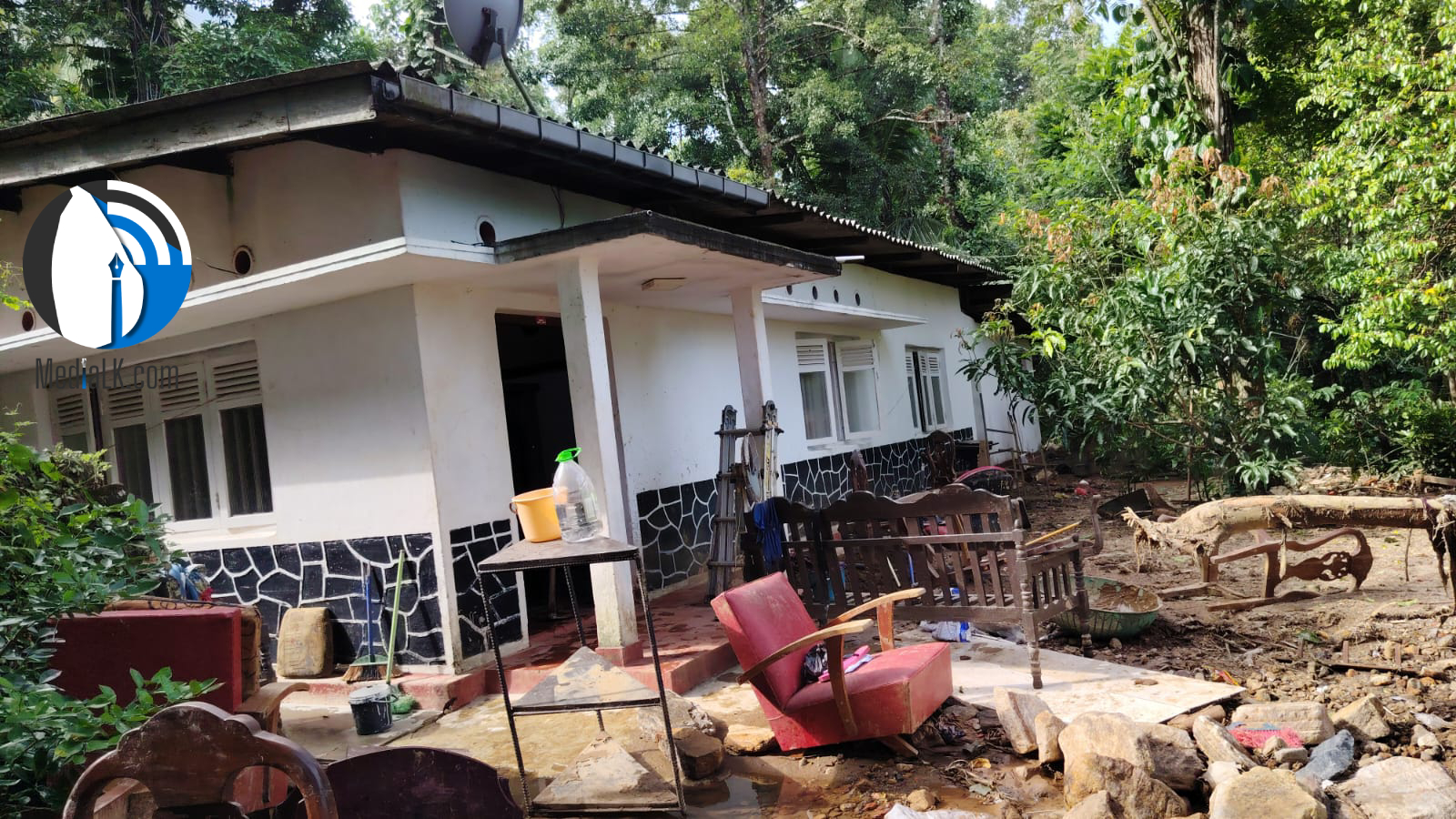
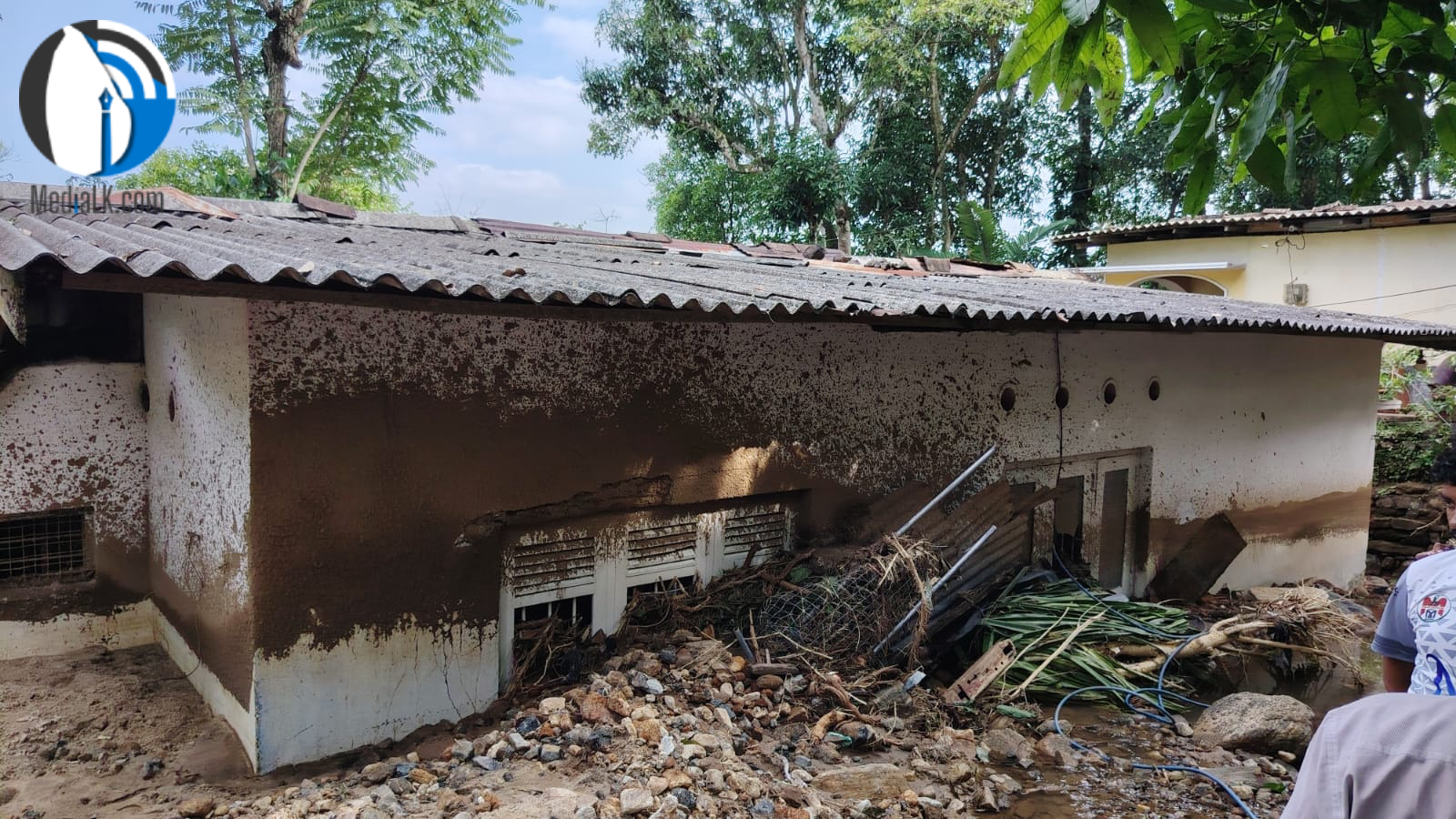
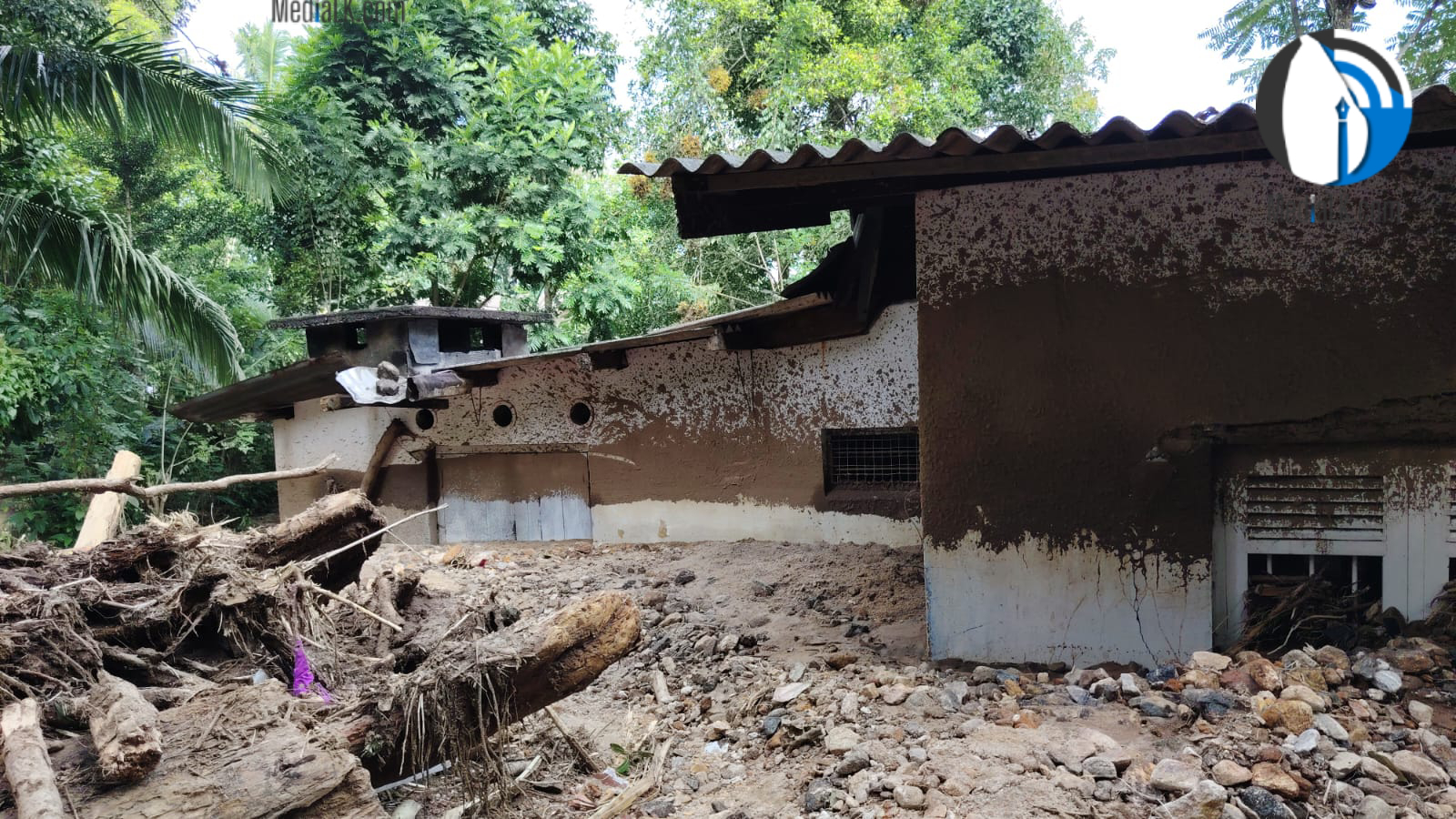
“When I reached there, the back of the house and the stream area were covered with massive stones. Some of them were too large to move. Those kinds of rocks had never been there before. I was terrified that my wife and son might be buried beneath them.”
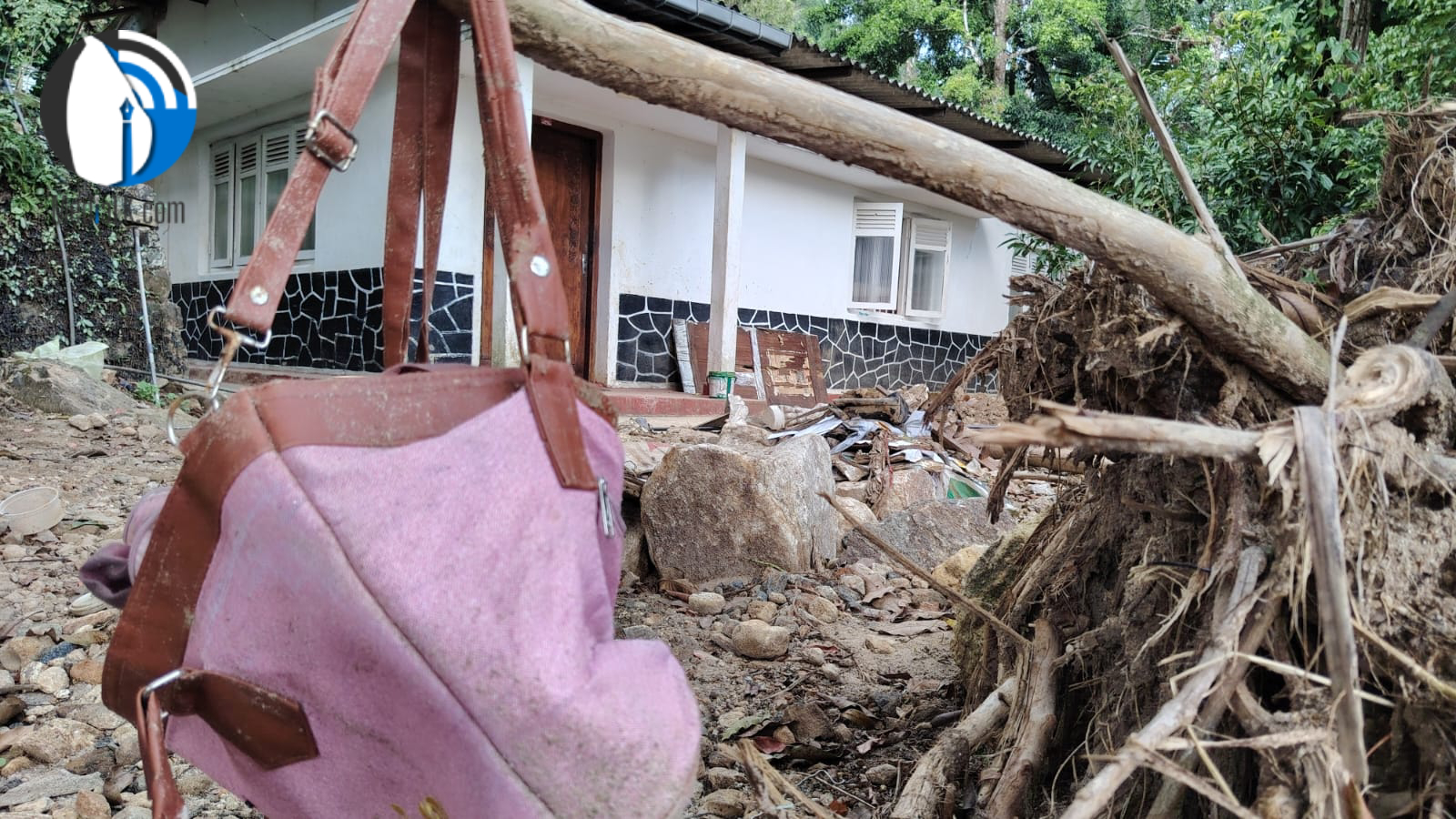
“Water several feet high was still flowing through the left side of the house and even inside it. Large tree trunks that had never been there before were scattered around. Despite all this, I searched for my wife and son. I also went down to the Janaraja Boys’ College playground. By then, the playground was filled with mud and stones. Even after searching through the night, I couldn’t find either of them.”
“By the morning of the 28th, I learned that several people from the houses below ours had been swept away. I was told that my son was among them. But there was still no news about my wife.”
“By then, Gampola town was also flooded. I went to Sinhapitiya and felt faint. At a nearby shop, I heard that a body had been found near a stream close to Janaraja Boys’ College.”
Only Two Hands Visible
“After that, I went to the Janaraja Boys’ College playground. Near the steps connecting the playground and the main hall, among branches, leaves, and rocks brought by the water, I saw only two hands raised above the debris. No other part of the body was visible.”
“But the moment I saw those hands, I knew it was my wife.”
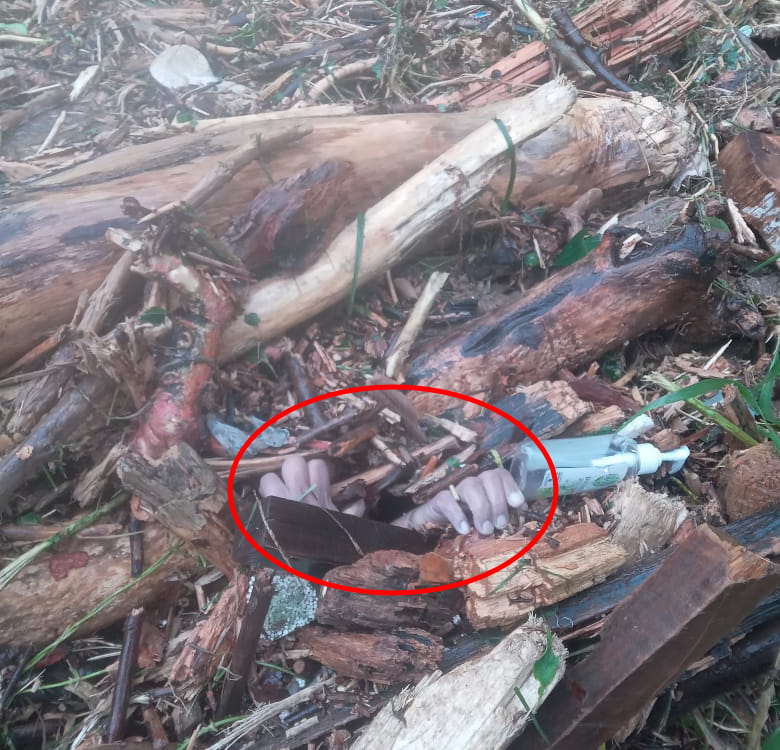
“Because Gampola was flooded, the police couldn’t come immediately. So, with the help of a teacher who was living in the school quarters and two police officers who were nearby, the body was recovered. It was my wife. After that, her body was taken to the Gampola Base Hospital.”
“While recovering my wife’s body, I learned from the people there that my head was injured. Accordingly, I was treated at Gampola Hospital.”
Mallika’s funeral was held on 30 November 2025 at the Gampola Bowala public cemetery. By then, the house they lived in had become uninhabitable. The back of the house was filled with soil and rocks; mud covered the interior; tree trunks lay scattered in the yard.
As a result, Shaminda and his son were forced to stay at a friend’s house. The son narrowly survived and had abrasions on several parts of his body.
About a week after the burial of Mallika, Shaminda was admitted to Gampola Hospital after experiencing trembling and numbness on the left side of his body, including his left arm and leg. He was later transferred to Kandy Hospital. Doctors informed his mother that the condition was likely caused by the shock of his wife’s death.
Since then, he and his son have continued to live at a friend’s house.
A Warning That Went Unheeded
“The rocks and tree trunks around our house after the incident were not there before. About a year ago, I saw a TV news report where the Divisional Secretary visited Ambuluwawa and warned not to push soil and rocks downhill, saying that during heavy rain it would flow into the villages and cause danger. No one took it seriously. People in nearby houses say the rocks came down from Ambuluwawa. If that warning had been heeded, my wife would not have lost her life,” Shaminda said.
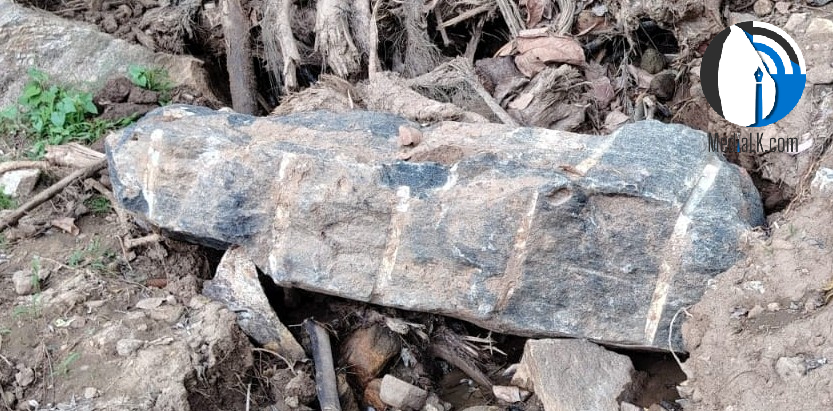
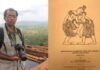
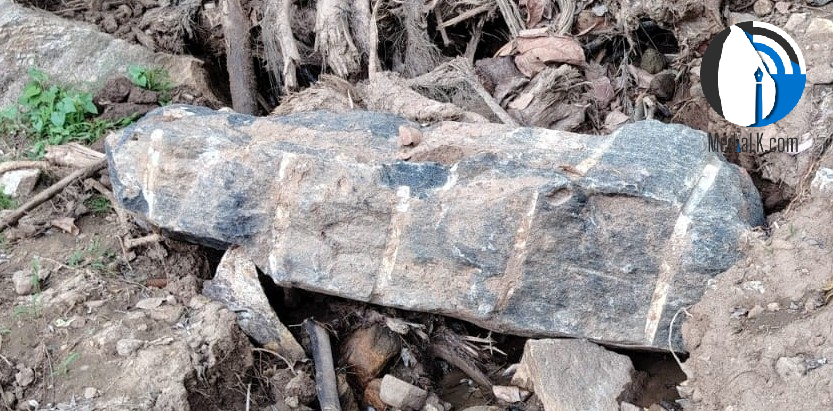
When we visited the area two days after the incident, it was clearly visible how blasted stones had come down from Ambuluwawa and become lodged in the stream. Drill marks were clearly visible on some of the stones.
There was no indication that the warning issued by the Divisional Secretary – Mrs Aathma Dilrukshi had been taken seriously by the Ambuluwawa Trust or by other institutions such as the Central Environmental Authority. In the end, Mallika Thebuwanarachchi lost her life.
Further investigation revealed that large quantities of rock blasting had taken place during the construction of the road leading to the summit of Ambuluwawa. Rocks had also been blasted for the construction of a Buddha statue and other structures. Some of these rocks had been pushed downhill and remained lodged among trees. Similar rocks were observed during visits to the Ambuluwawa mountain.
The Auditor General’s Report of 2023 noted the following:
“In 2019, stones were broken for the construction of a stone statue, but these stones were not used for any purpose and were neither sold. During the year under review, a total of Rs.157,500 was paid for the supply of 16 cubic meters of stones for the Trust Fund’s requirements.”
In its explanation, Ambuluwawa stated that because the area was sloped, rocks fell into the precipice during blasting, and the remaining rock blocks were too large to be used.
Auditor General’s recommend was follows.
“The removed stones should be either utilized for other construction activities within the premises or properly disposed of or sold in a regulated manner.”
The Auditor General’s Report for 2020 further stated:
“A mechanism had not been put in place to measure the amount of rubble removed for making a Buddha statue. Action had not been taken either to sell those granite or use on any other useful purpose; and 2,185.14 cubic meters of removed rubble with a market value of Rs. 9,833,130 did not exist at the site, but action taken in that connection was not disclosed as well.”
Ambuluwawa’s explanation, as recorded in the report, stated:
“The pieces of stones thrown away while quarrying land on the nearby cliff. The stones remaining on the road are measured, thrown down the cliff.”
The institution itself has admitted that stones were pushed downhill from Ambuluwawa. The next critical question is: who allowed rock blasting in such an environmentally sensitive area with residential settlements at the foothills?
Despite the Auditor General highlighting this issue in the 2020 report, there is no visible action taken by the authorities. Until the Divisional Secretary, Athma Dilrukshi, raised the issue, authorities appeared to ignore it—and even after her disclosure, no meaningful action was taken.
The Legal Context
The ultimate result of irregular road construction and development was the death of teacher Mallika Thebuwanarachchi and injuries to several others.
Penal Code Section 327 states that any person who commits a rash or negligent act endangering human life or personal safety shall be punished with imprisonment up to three months, or a fine up to one hundred rupees, or both.
Penal Code Section 329 states that if such a rash or negligent act causes grievous hurt, the offender shall be punished with imprisonment up to two years, or a fine up to one thousand rupees, or both.
Penal Code Section 298 states that if a person causes death by a rash or negligent act not amounting to culpable homicide, the offender shall be punished with imprisonment up to five years, or a fine, or both.
Under Section 28 of the Mines and Minerals Act No. 33 of 1992, a permit must be obtained from the Geological Survey and Mines Bureau for rock blasting. Ambuluwawa has carried out rock blasting on several occasions, placing a serious responsibility on the Geological Survey and Mines Bureau in this incident.
The National Environmental Act and the numerous regulations issued under it provide for environmental protection and for the regulation of human activities within sensitive and specific ecological systems. However, in the case of Ambuluwawa, it is clearly evident that these laws and regulations were not implemented, as demonstrated by the quarrying of black stone and the rolling of large rock fragments down the hillside.
In relation to Ambuluwawa, numerous state institutions—including the Ambuluwawa Trust Fund, Central Environmental Authority, National Building Research Organization, Geological Survey and Mines Bureau, Divisional Secretariat, local authorities, Ministry of Environment, Department of Public Trustee, Ministry of Buddha Sasana, BOI, Ministry of Agriculture, Department of Wildlife Conservation and the Police—had regulatory responsibilities.
Had these institutions intervened in a timely manner, it would have been possible to stop blasting in an ecologically sensitive area like Ambuluwawa and to prevent rocks from being pushed downhill in a dangerous manner.
The Supreme Court of Sri Lanka has discussed the Public Trust Doctrine in several judgments. In the Fundamental Rights case filed against the Chunnakam Power Plant by Dr. Ravindra Kariyawasam, the Court extensively examined the doctrine and highlighted how the Central Environmental Authority violated it. Justice Prasanna Jayawardhana stated in the Chunnakam case (SC FR Application No. 141/2015) as follows.
“The BOI and the CEA were required to perform these duties and obligations vested in them by the provisions of Part IV C of the Act and the National Environmental (Procedure for approval of projects) Regulations No. 1 of 1993 keeping in mind that doing so was not only their statutory and regulatory duty but also that these powers have been conferred on them in the public trust. This Court has, in several decisions such as WIJEBANDA vs. CONSERVATOR GENERAL OF FORESTS, SUGATHAPALA MENDIS vs. CHANDRIKA KUMARATUNGE [2008 2 SLR 339], ENVIRONMENTAL FOUNDATION LTD vs. MAHAWELI AUTHORITY OF SRI LANKA and PREMALAL PERERA vs. TISSA KARALIYADDE [SC FR 891/2009 decided on 31st March 2016], recognised and given effect to the public trust doctrine.”
The same principle applies to Ambuluwawa.
Chapter VI of the Constitution, under the Directive Principles of State Policy, states as follows in Article 25(8):
“The State shall ensure that the operation of the economic system does not result in the concentration of wealth and the means of production to the common detriment.”
Article 25(14) further states:
“The State shall protect, preserve and improve the environment for the benefit of the community.”
Although several other provisions in the same chapter are also directly relevant to this incident, it appears that the relevant institutions have failed to give adequate attention to these matters. With regard to the Directive Principles of State Policy, Justice Prasanna Jayawardhana has also stated the following in the above-mentioned judgment.
“The Directive Principles of State Policy are not wasted ink in the pages of the Constitution. They are a living set of guidelines which the State and its agencies should give effect to. Thus, where a petitioner complains of a violation of his fundamental rights arising from the breach of a statutory or regulatory duty by the State or an agency of the State, a demonstration that the violation is also in contravention of one or more of the Directive Principles of State Policy, will lend strong support to his case. In the present application, the petitioner‟s complaint that the BOI and the CEA have failed to perform their duty of ensuring that the provisions of Part IV C of the Act and the National Environmental (Procedure for approval of projects) Regulations No. 1 of 1993 [including obtaining and considering an IEER or EIAR] were complied with when the 8th respondent increased the power generating capacity of its thermal power station, point to a failure on the part of BOI and the CEA to give effect to Article 27 (14) of the Constitution which declares that one of the Directive Principles of State Policy is that the State [and its agencies] “….. shall protect, preserve and improve the environment for the benefit of the community.”
Justice Jayawardhana farther stated that,
“This approach is reflected in Principle 1 of the Rio Declaration, which declares “Human beings are at the centre of concerns for sustainable development. They are entitled to a healthy and productive life in harmony with nature.” and Principle 4 which asserts that “In order to achieve sustainable development, environmental protection shall constitute an integral part of the development process and cannot be considered in isolation from it.”. It may be mentioned here that the term `Sustainable Development‟ emerged in 1987 in the Brundtland Commission‟s report titled “Our Common Future” which succinctly described `sustainable development‟ as “development that meets the needs of the present without compromising the ability of future generations to meet their own needs.”. In WIJEBANDA vs. CONSERVATOR GENERAL OF FORESTS, Tilakawardane J. described sustainable development [at p. 359] as “The phrase „sustainable development‟ encapsulates the meaning that natural resources must be utilized in a sustainable manner, in keeping with the principle of intergenerational equity. This requires that the State as the guardian of our natural resource base does not compromise the needs of future generations whilst attempting to meet and fulfill the present need for development and commercial prosperity or short term gain.”.
The same principle applies to Ambuluwawa. Various international recognitions and frameworks have already been established to protect not only human rights but also the rights of wildlife. In such a context, the tragedy at Ambuluwawa can be regarded as a blatant disregard—indeed a trampling—of all these accepted principles by certain responsible authorities in Sri Lanka.
Accordingly, the death of Mallika Thebuwanarachchi and the damage to houses were not merely the result of a natural disaster, but the consequence of human actions carried out by an institution established under a law passed by Parliament—and the failure of other state institutions to properly regulate it. Justice for Mallika Thebuwanarachchi does not end with compensation of ten million rupees. True justice lies in preventing such tragedies in the future and in enforcing the law against those responsible.